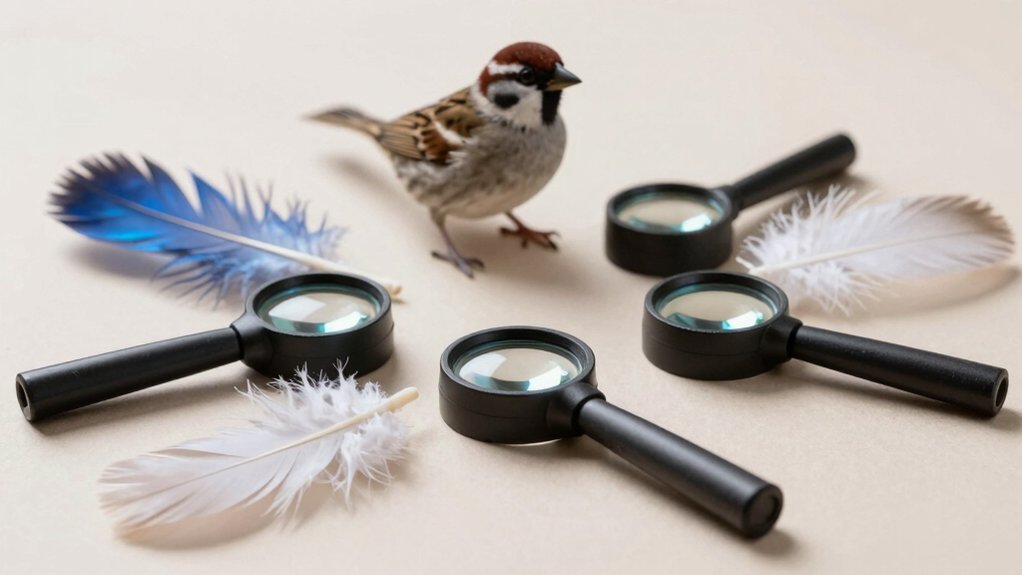
You’re examining bird feathers, and you need the right magnification tool—but not every loupe performs equally for this specialized work. The difference between a basic magnifier and one built for precision analysis can transform what you’re able to observe in feather structure, pigmentation, and microscopic detail. Let’s explore which models will genuinely serve your ornithological needs.
| JARLINK 30X 60X Illuminated Jewelers Loupe Magnifier |  | Best Dual Magnification | Magnification Power: 30X, 60X | Illumination Type: LED light | Portability: Foldable, pocket-sized with fabric bag | CHECK ON AMAZON | Read Our Analysis |
| JARLINK 3 Pack Jewelers Loupe with UV and LED Light |  | Most Versatile Option | Magnification Power: 30X, 60X, 90X | Illumination Type: LED light, UV black light | Portability: Foldable, pocket-sized | CHECK ON AMAZON | Read Our Analysis |
| Rongon 10X Jewelers Loupe Magnifying Glass with Necklace |  | Stylish & Portable | Magnification Power: 10X | Illumination Type: None | Portability: Wearable necklace pendant | CHECK ON AMAZON | Read Our Analysis |
| Jewelers Loupe Magnifier 30x Foldable Pocket Glass |  | Best Glass Quality | Magnification Power: 30X | Illumination Type: None | Portability: Foldable pocket glass with storage case | CHECK ON AMAZON | Read Our Analysis |
| JARLINK Jewelers Loupe 30X 60X 90X Illuminated Magnifier |  | Professional UV Detection | Magnification Power: 30X, 60X, 90X | Illumination Type: LED light, UV black light | Portability: Foldable, pocketable design | CHECK ON AMAZON | Read Our Analysis |
More Details on Our Top Picks
JARLINK 30X 60X Illuminated Jewelers Loupe Magnifier
Are you an ornithologist or birdwatcher seeking to examine feather microstructures with precision? The JARLINK 30X 60X Illuminated Jewelers Loupe Magnifier delivers exactly what you need. Its dual-lens design—a primary 30x22mm lens and supplementary 60x12mm lens—lets you toggle between magnification levels depending on feather detail requirements. The integrated LED illumination ensures optimal visibility at any angle, while the lightweight aluminum construction keeps your field kit portable. You’ll appreciate the automatic light switching between lenses, eliminating manual adjustments. Simply position the lens close to your specimen for crisp clarity. The included fabric bag protects your investment during outdoor expeditions, and button batteries ensure reliable performance whenever you’re analyzing plumage characteristics.
- Magnification Power:30X, 60X
- Illumination Type:LED light
- Portability:Foldable, pocket-sized with fabric bag
- Lens Material:Aluminum and plastic construction
- Primary Application:Gems, jewelry, coins, stamps, rocks, watches, antiques
- Battery Requirement:3 LR1130 button batteries included
- Additional Feature:Dual lens configuration switching
- Additional Feature:Included fabric storage bag
- Additional Feature:Aluminum and plastic construction
JARLINK 3 Pack Jewelers Loupe with UV and LED Light
Whether you’re examining intricate feather barbs or scrutinizing minute structural details, the JARLINK 3 Pack Jewelers Loupe delivers the magnification you’ll need for precise ornithological work. This three-loupe set gives you 30X, 60X, and 90X magnifications—perfect for analyzing feather variations at different scales. The integrated LED and UV lighting illuminate specimens without casting shadows, while the foldable aluminum and plastic construction keeps your kit portable for field observations. You’ll appreciate the included batteries and cleaning cloth, ensuring you’re ready immediately. At under eight ounces, you’ll easily slip this into your field pack for on-site feather identification and documentation.
- Magnification Power:30X, 60X, 90X
- Illumination Type:LED light, UV black light
- Portability:Foldable, pocket-sized
- Lens Material:Acrylic lenses with aluminum alloy frame
- Primary Application:Gems, jewelry, diamonds, coins, stamps
- Battery Requirement:Batteries included with extras
- Additional Feature:UV black light detection
- Additional Feature:Three magnification levels available
- Additional Feature:Iron plate base included
Rongon 10X Jewelers Loupe Magnifying Glass with Necklace
If you’re seeking a magnifying tool that doesn’t sacrifice style for functionality, the Rongon 10X Jewelers Loupe delivers both in one charming package. This necklace-style magnifier features a creative owl pendant design that you’ll wear as fashionable jewelry. The 1.18-inch optical glass lens provides 10X magnification with exceptional sharpness and clarity for detailed feather analysis. Its metal and glass construction ensures durability while maintaining portability. You’ll appreciate having your magnification tool readily accessible around your neck during fieldwork. Whether you’re examining delicate feather structures, stamps, gems, or fine print, this versatile loupe combines practicality with elegant style—ideal for professionals and enthusiasts alike.
- Magnification Power:10X
- Illumination Type:None
- Portability:Wearable necklace pendant
- Lens Material:Glass lens
- Primary Application:Jewelry, gems, stamps, maps, reading
- Battery Requirement:No batteries required
- Additional Feature:Owl pendant necklace design
- Additional Feature:1.18 inch optical glass
- Additional Feature:Wearable fashion accessory
Jewelers Loupe Magnifier 30x Foldable Pocket Glass
You’ll find the 30X magnification and crystal-clear real glass lens invaluable when you’re examining intricate bird feather details that’d otherwise escape the naked eye. The foldable design fits easily into your pocket or attaches to a keychain, making fieldwork convenient. Its durable zinc alloy frame withstands outdoor use without warping or breaking. The included storage case protects the glass during transport. Whether you’re analyzing barbs, barbules, or color patterns on feathers, this loupe delivers the magnification power you need. It’s also versatile enough for jewelry inspection, coin collecting, or stamp examination, making it a practical investment for serious birders and hobbyists alike.
- Magnification Power:30X
- Illumination Type:None
- Portability:Foldable pocket glass with storage case
- Lens Material:Real glass material with zinc alloy frame
- Primary Application:Jewelry, coins, gems, diamonds, watch repair, reading
- Battery Requirement:No batteries required
- Additional Feature:Included storage case provided
- Additional Feature:Zinc alloy metal frame
- Additional Feature:Neck chain attachment loop
JARLINK Jewelers Loupe 30X 60X 90X Illuminated Magnifier
The JARLINK Jewelers Loupe stands out for hobbyists and professionals who need versatile magnification across multiple power levels. You’ll appreciate the three magnification options—30X, 60X, and 90X—letting you zoom from broader feather structure to intricate barb details. The built-in LED and UV lights illuminate specimens clearly, while the UV function reveals fluorescent markings invisible to naked eyes. Its compact, foldable aluminum design fits easily in your pocket, and pre-installed batteries get you started immediately. With interchangeable lenses and adjustable focus through distance control, you’re equipped for detailed feather analysis in any field setting.
- Magnification Power:30X, 60X, 90X
- Illumination Type:LED light, UV black light
- Portability:Foldable, pocketable design
- Lens Material:Acrylic lenses with aluminum alloy frame
- Primary Application:Gems, jewelry, diamonds, coins, stamps, minerals, antiques
- Battery Requirement:Pre-installed batteries with spare included
- Additional Feature:UV fluorescence detection capability
- Additional Feature:Three lens magnification options
- Additional Feature:Pre-installed with spare batteries
Factors to Consider When Choosing a Jeweler’s Loupe for Microscopic Bird Feather Analysis
When you’re selecting a jeweler’s loupe for bird feather analysis, you’ll need to balance magnification power—typically 30X to 90X—with lens clarity and optical quality to capture fine structural details. You’ll also want to evaluate the illumination system, as LED lighting helps you spot microscopic features without distorting colors or introducing shadows that obscure your observations. Finally, consider the durability of the frame materials and whether you need a portable design for fieldwork, since a loupe that won’t withstand outdoor conditions won’t serve you well in the long run.
Magnification Power Requirements
How do you know which magnification level truly serves your feather analysis needs? You’ll want to match magnification to your specific objectives. At 30x, you can assess overall feather contour and general patterning effectively. However, if you’re examining barbule structure and microscopic barb details, you’ll need 60x–90x magnification to reveal these finer features.
Consider investing in a dual-lens loupe offering 30x/60x or 30x/60x/90x capabilities. This flexibility lets you start with lower magnification for orientation, then switch to higher power for detailed inspection without changing tools.
Keep in mind that higher magnification reduces depth of field significantly. You’ll need precise focal distance and stable positioning to maintain sharp images at 60x–90x. Position the feather within just a few millimeters of the lens to preserve clarity.
Lens Clarity and Optical Quality
Once you’ve selected your magnification range, you’ll discover that optical quality becomes your next critical consideration. The material of your lens directly impacts what you’ll see in feather microstructures. Real glass or high-quality acrylic lenses minimize chromatic aberration and edge blur, allowing you to discern fine barb details clearly. You’ll want to position your loupe close to the feather surface—distance causes image deterioration and potential inversion. Built-in LED illumination with adjustable angles proves invaluable, providing uniform, shadow-free lighting that reveals intricate barb patterns and microstructural features. Multi-magnification designs offering switchable lenses let you compare features across different scales without repositioning your specimen. Together, these optical factors ensure you capture the precision needed for accurate feather analysis.
Illumination for Fine Detail
Why does lighting matter so much when you’re examining feather microstructures? You’ll quickly discover that inadequate illumination obscures the finest details you’re trying to analyze. A well-positioned LED light delivers consistent, shadow-free illumination that reveals barbule edges and barb coloration without glare or hotspots.
Adjustable brightness becomes essential—you’ll need to balance illumination intensity with contrast to distinguish microscopic features effectively. Consider loupes offering side-switching or adjustable LED positioning, which lets you optimize the lighting angle for different feather orientations and minimize specular reflections that wash out details.
UV lighting can help detect fluorescence in organic residues, though you’ll want to verify filter settings preserve visible color accuracy. A bright, uniform source also reduces the temptation to position intrusive lighting too closely, preserving natural feather texture during analysis.
Portability and Field Use
When you’re examining bird feathers in the field, you’ll quickly realize that a loupe’s portability can make or break your fieldwork efficiency. You’ll want a compact, foldable design that fits comfortably in your pocket without adding bulk to your gear. Look for models weighing around 7 ounces or less—this lightweight construction prevents fatigue during extended examination sessions.
A protective carrying case becomes essential for protecting your investment during rugged fieldwork. You should prioritize durable frames made from aluminum alloy, which withstand demanding environments while remaining lightweight. Two-lens or multi-magnification setups let you switch between 30X and 60X magnification without carrying multiple tools. This versatility streamlines your workflow and keeps your hands free for note-taking and specimen handling throughout your bird feather analysis sessions.
Durability of Frame Materials
Your loupe’s frame material directly impacts its longevity in the field. Zinc alloy and aluminum alloy frames provide superior impact resistance compared to plastic, crucial when you’re examining feathers in unpredictable outdoor conditions. Metal frames withstand accidental drops better, though they’re heavier and susceptible to corrosion without proper treatment.
When selecting your loupe, prioritize corrosion-resistant screws and hinges that maintain optical alignment through repeated use. Foldable designs with secure joints prevent lens misalignment during transport and storage. Reinforced connection points at the lens-holder reduce wear from frequent magnification switching.
Consider your environment carefully. If you’ll work in humid or wet conditions, invest in a treated metal frame. For dry climates, untreated metal poses minimal risk while delivering the durability you need for consistent field performance.
Frequently Asked Questions
How Do I Properly Clean and Maintain a Jeweler’s Loupe for Feather Analysis?
You’ll clean your loupe with a soft microfiber cloth and distilled water. Don’t use harsh chemicals. Store it in a protective case away from dust. You should inspect the lens regularly for scratches or debris buildup.
What Magnification Level Is Best for Identifying Rare Bird Species by Feathers?
You’ll want 10x magnification for identifying rare bird species by feathers. It’s powerful enough to reveal barb details and pigmentation patterns, yet you’ll maintain a comfortable working distance without eye strain during extended analysis.
Can Jeweler’s Loupes Detect Feather Damage From Predators Versus Natural Molting?
You can distinguish predator damage from natural molting with a jeweler’s loupe. Predator attacks create irregular tears and puncture marks, while molting shows clean, symmetrical feather loss at the shaft base. You’ll notice the difference immediately.
How Does Lighting Quality Affect Accuracy in Feather Texture and Color Analysis?
You’ll find that poor lighting distorts feather colors and obscures fine texture details, making accurate analysis nearly impossible. You need bright, consistent illumination to distinguish subtle color variations and identify microscopic damage patterns reliably.
Are Jeweler’s Loupes Suitable for Field Research or Only Laboratory Settings?
You’ll find jeweler’s loupes work well in both settings. You can take them into the field for preliminary feather examination, though you’ll need steady hands and natural light. Lab settings offer better lighting control for detailed color and texture analysis.

Leave a Reply